
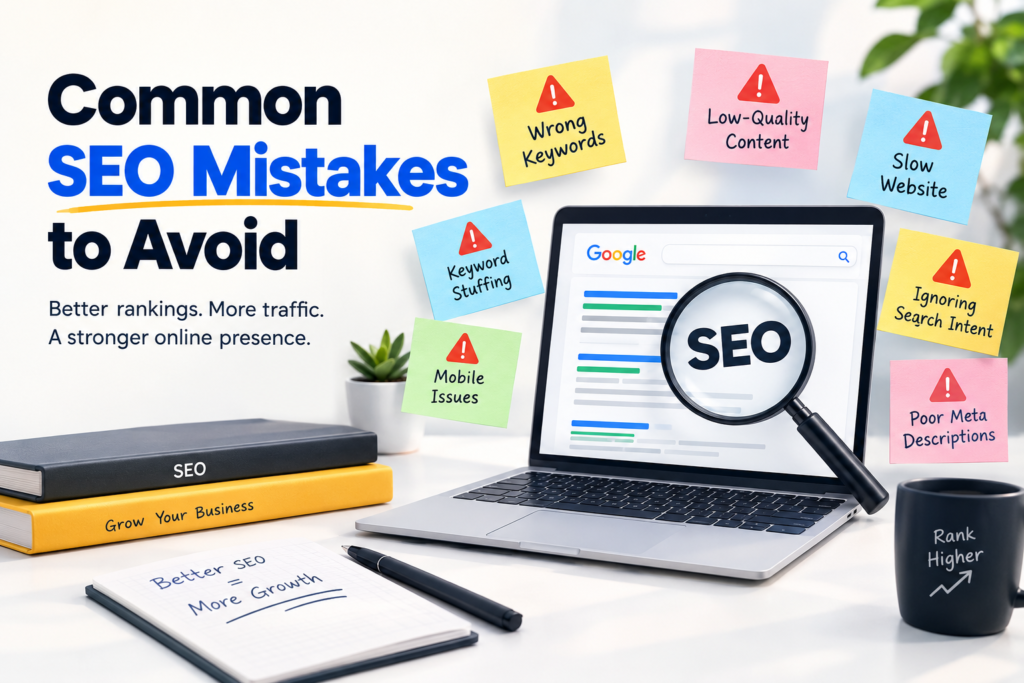
Common Seo Mistakes to Avoid
SEO is among the best digital marketing methods that help generate organic traffic, build your brand, and get more leads. But even the top websites may fail to achieve good search engine rankings because of some SEO errors. The truth is that search engines such as Google keep updating their algorithm in order to ensure that users get the best results. This means that using outdated methods and making certain avoidable SEO mistakes can influence the effectiveness of your website.
Be it a business owner, blogger, or digital marketer, having information about these mistakes will help you get better rankings and offer your visitors an improved user experience. In this article, we’ll discuss the SEO mistakes that negatively influence ranking.
1. Ignoring Keyword Research
Creating content without conducting keyword research is one of the most common mistakes in SEO. The keywords are search terms people enter in search engines to find anything – information, product or services. Without knowing what us
Beginners often choose either competitive keywords or do not incorporate any keywords into their content at all. You should be looking for keywords that have reasonable levels of search and competition. The long-tail keywords, being more specific than regular ones, usually face less competition and bring targeted traffic.
Fix:
Use keyword research tools to discover keywords.
Choose one primary keyword and some secondary ones for each page.
Integrate keywords into titles, headings, URLs and text.
2. Keyword Stuffing
In the past, if you repeated a certain keyword numerous times, it could be helpful for improving your rankings. However, these days using a keyword stuffing strategy can be viewed as bad SEO. Search engines understand that a certain word appears inappropriately on a page, and they lower your ranking as a consequence.
For instance, repeating the phrase “best digital marketing agency” many times in your text makes it hard to read and gives poor user experience.
How to solve the problem:
Use your natural language.
Utilize synonyms and related terms.
3. Publishing Low-Quality Content
The content is what SEO starts with.“If your content is thin, duplicated, or low quality, it offers little value to users, fails to satisfy search intent, and may struggle to rank well in search results.” It is better for search engines if you create content which shows your expertise, gives an answer to people’s queries and fulfills their search intent.
If your posts are too short, lack information or are just copies of something you have found on other websites, then your ranking can be bad.
How to fix it:
- Create informative content.
- Update old posts.
- Address your audience’s needs.
4. Ignoring Search Intent
A lot of sites try to optimize for keywords not knowing what is the motive behind the searches.
“Search intent refers to the purpose or goal behind a user’s search query and what they are looking to find online.”
For instance, when a person enters “how to increase site speed” into the search bar, he or she needs some educational content.
In case users enter “SSD hosting buy,” then their goal is to make purchases.
What steps can you take to fix the issue?”
First, analyze the currently existing pages.
Second, write content corresponding to user expectations.
Third, answer the question immediately.
5. Poor Title Tags and Meta Descriptions
Title tags and meta descriptions help get clicks from the search engine results page.
Generic titles mean lower chances of appearing and getting clicks.
An effective title will contain the main keyword and be a description of the page contents.
How to solve this problem:
Make sure to have a unique title on each of your pages.
Keep titles short and informative.
Generate convincing meta descriptions to make people want to click.
6. Slow Website Speed
Website speed is not only a ranking signal but also an element of user experience. Users expect fast-loading pages. If your site is slow, most users will leave your page without even checking your content.
Some common reasons why sites are slow include big pictures, bad hosting, excess plugins, and extra code.
How to fix it:
Reduce the size of the picture before uploading.
Turn on browser caching.
Get CDN.
Minimize CSS and JavaScript files.
Select good hosting..
7. Not Optimizing for Mobile Devices
Website browsing has shifted to smartphones for most internet users.
Google has adopted mobile-first indexing, where it assesses the mobile version of your website.
A website that is not mobile-friendly will rank lower in search engines and irritate the users.
Solution:
Adopt responsive web design.
Ensure that navigation buttons and menus are easily usable from mobile devices.
Test the website on various devices.
Make the website fast to load on mobile devices.Website browsing has shifted to smartphones for most internet users.
Google has adopted mobile-first indexing, where it assesses the mobile version of your website.
A website that is not mobile-friendly will rank lower in search engines and irritate the users.
Solution:
Adopt responsive web design.
Ensure that navigation buttons and menus are easily usable from mobile devices.
Test the website on various devices.
Make the website fast to load on mobile devices.
8. Broken Links and Crawl Errors
Not only do broken links affect your visitor’s experience negatively but also prevent the crawler from accessing your website appropriately. Dead links will take up the crawling budget of the website and reduce the overall quality of the website.
Solution:
Periodically conduct an audit on your website for broken links.
Implement redirects for the deleted pages when needed.
Update the broken internal links.
Use website analysis tools to track crawl errors.
9.Missing Image Optimization
Images enhance user interaction but can slow down your site if not optimized. Furthermore, search engines cannot understand images completely without any description.
What to do:
Image compression without compromising on the quality of the image.
Giving descriptive file names.
Adding alt text to the image.
Opting for modern image formats wherever applicable.
10. Weak Internal Linking
Internal linking will help the search engine understand the structure of your website as well as provide visitors with links to relevant pages. Most of the websites lack proper internal links that can affect SEO.
Solution:
Connect relevant articles.
Use descriptive anchor text.
Make topic clusters for key subjects.
Give internal links to all important pages.
11. Duplicate Content
This happens when identical or near identical copies of content appear on more than one page. It can be hard for search engines to decide which page deserves ranking.
Some of the causes of duplicate content include product description, printer-friendly version of the web page, and use of more than one URL for the same content.
The solutions include:
Creating original content.
Using canonical tags.
Not copying content from other sites.
12. Neglecting Technical SEO
Good content will fail to rank if your website is not easily crawlable and indexable by search engines.
Technical SEO is all about making sure you have elements like XML sitemaps, robots.txt files, HTTPS, structured data, etc.
How to fix it:
Submit an XML sitemap.
Secure your website with HTTPS.
Optimize your Core Web Vitals.
Resolve any crawl or indexing problems.
Structure your website properly.
13. Ignoring Backlink Quality
Backlinks continue to be one of the most influential ranking factors. But not all backlinks are good. Spammers and low-quality backlinks might ruin the reputation of your website.
What to do:
Get backlinks by creating quality content.
Create guest posts for other trustworthy websites.
Build connections in your field.
Do not buy or participate in any link-building campaigns.
14. Not Updating Old Content
SEO is not a one-time process. Information gets out-of-date, new articles appear, and trends change.
Articles with outdated information will slowly drop from search engines if they are not updated.
Solution:
Check your older content regularly.
Update statistics and examples.
Write new sections about new developments.
Improve formatting.
15. Ignoring User Experience (UX)
Search engines today prefer sites that give the user a positive experience. Sites with hard navigation, pop-ups, bad layout, and poor readability deter people from remaining on your website.
This will improve the user experience, resulting in higher sessions, page views, and better SEO ranking.
How to fix it:
Have good navigation.
Increase page readability.
Limit pop-ups.
Use good headings, lists, and space.
Best Practices for Better SEO
In order to retain good rankings, you need to follow these tips:
Do keyword research prior to developing content.
Prioritize user intent over the needs of the search engine.
Create unique, value-laden and organized content.
Improve page speed and mobile performance.
Gain quality backlinks through natural means.
Check for technical SEO problems frequently.
Refresh your older content to keep it current.
Analyze your site performance with the help of search tools and analytics.
Conclusion
In other words, no hacks can be found in successful SEO. Such SEO mistakes as improper keyword research, slow website loading speed, duplicate content, bad internal linking and neglect of technical SEO can negatively influence your ranking at search engines. Still, such mistakes are easily avoidable and quite simple to fix.
Remember that SEO is an ongoing process. SEO is not something you do once in your life. SEO techniques evolve, demands of users change and your competitors update their sites. Through continuous optimization of both the content and technical side of your site, you will be able to build a strong web presence that will rank well at search engines for many years to come.
By ensuring you avoid making SEO mistakes, you will not only increase your ranking but also improve the experience of your visitors.
Advantages of smm
Brand recongnition ad recall lift
Hi, this is a comment.
To get started with moderating, editing, and deleting comments, please visit the Comments screen in the dashboard.
Commenter avatars come from Gravatar.